
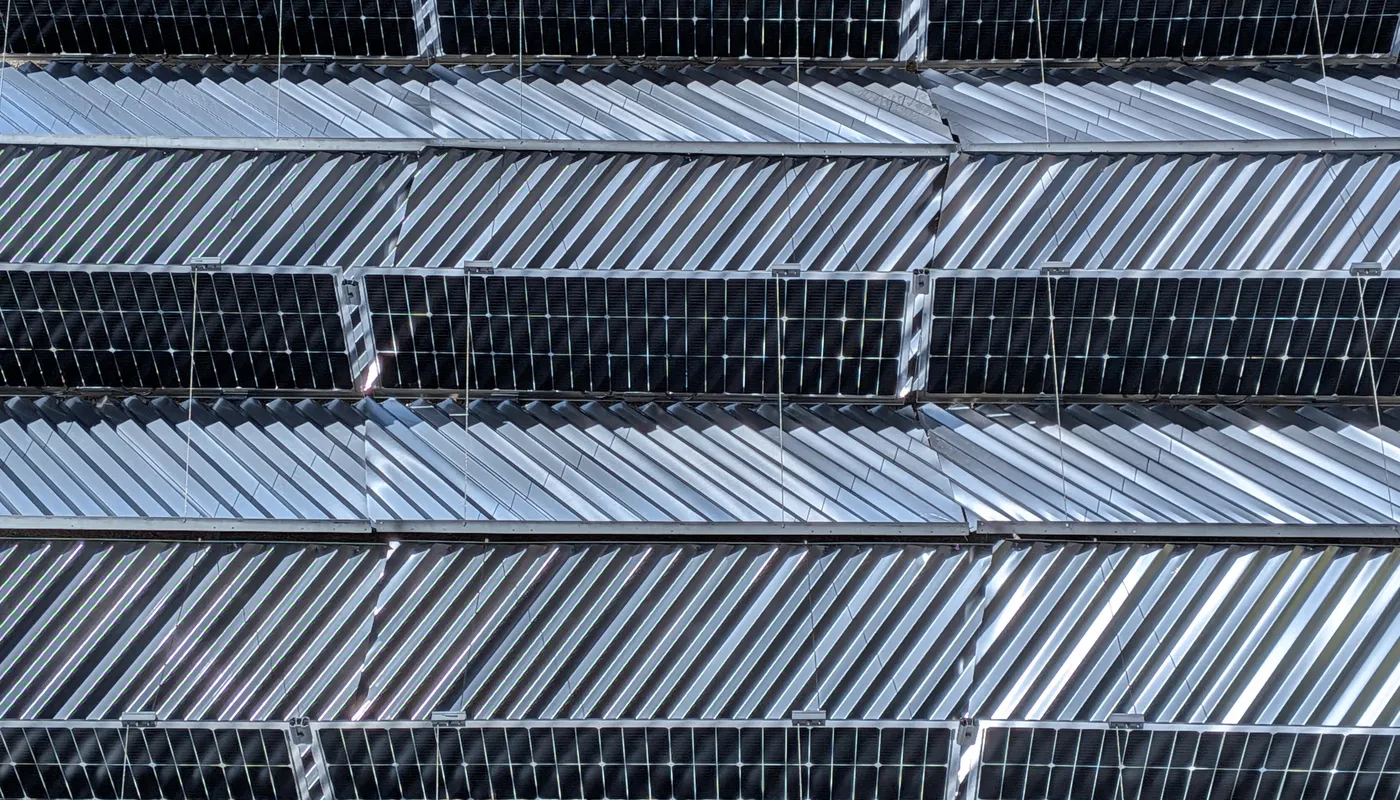
In short: in a measurement in Madrid (June 2026), soiling reduced the performance of Vecthor (V5) by only 0.3%, compared with 2.2% for a reference fixed-tilt system. The reason is optical: dust blocks the light that has to pass through a module's glass, but on a reflector it scatters the light, and much of that scattered light still reaches the bifacial module.
Anyone who runs a solar PV plant knows that soiling has a double impact: the energy that is not produced and the cost of the cleanings needed to recover it. At FutureVoltaics we have seen for some time that Vecthor, our system of vertical bifacial solar panels with reflectors, is much less sensitive to this problem than a conventional installation. In this article we explain why, with data measured at an installation in Madrid and the optical mechanism behind it.
How much soiling costs in solar PV
Soiling is one of the most significant operating losses. The IEA-PVPS Task 13 report on soiling losses (IEA-PVPS T13-21:2022) estimates that it reduces annual PV production worldwide by 3 to 5%, with an economic impact in the order of 3 to 5 billion euros across lost energy, cleaning costs and mitigation measures. The work of Ilse et al. (Joule, 2019) analyses the techno-economic impact of soiling and the strategies to mitigate it.
The size of the loss depends heavily on the site. In dry climates with little rain, such as much of the Iberian Peninsula in summer, dust builds up for weeks with nothing to wash it away. In practice, self-consumption installations below 1 MW are usually cleaned once a year at most, so soiling losses simply accumulate between cleanings and are accepted. That is why it matters so much how strongly soiling affects each technology: with the same cleaning schedule, the one that loses least produces most.
What dust does to light: absorption and scattering
A dust particle on a surface does two things to the light that reaches it: it absorbs part of it and scatters the rest in many directions. The end result depends on the surface underneath.
On the glass of a solar module
In a conventional module, light has to pass through the front glass to reach the cell. Dust reduces that transmission: absorbed light is lost, and light scattered backwards or at very shallow angles does not reach the cell either. That is why dirt on the module translates fairly directly into lost production.
On a reflector
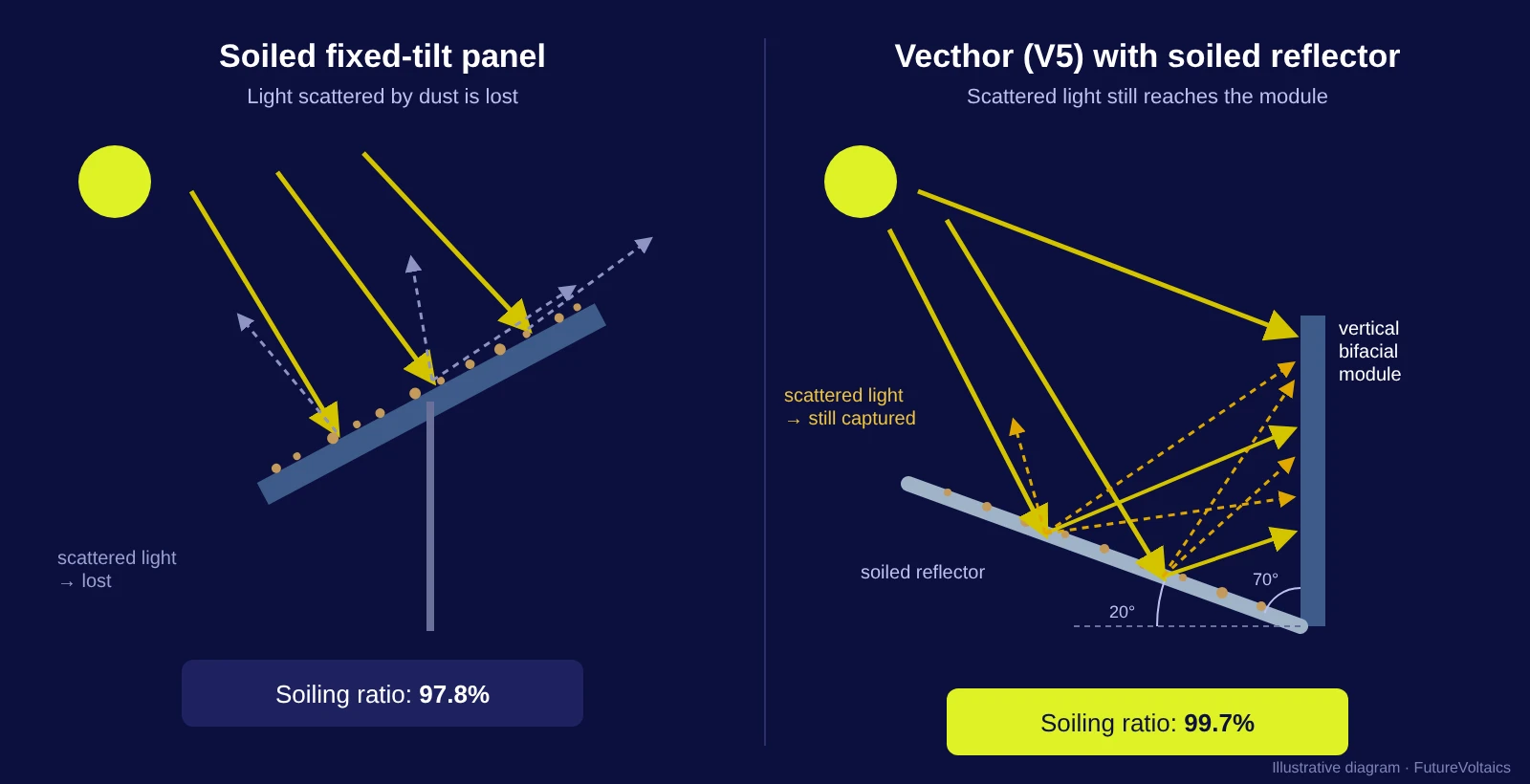
On a reflector, light does not have to pass through anything: it has to go back up. When the reflector is clean, the reflection is mostly specular, like a mirror. When it is dirty, part of that reflection becomes diffuse: light leaves in many directions instead of one. But it still leaves towards the upper hemisphere, and that is where the module is.
In Vecthor, the bifacial modules are arranged next to horizontal reflectors, so the module “sees” a very large fraction of the reflector. Much of the light scattered by the dust still ends up on one of the faces of the module. In other words, dirt sharply reduces optical transmission but has little effect on total hemispherical reflection. We already described this in our article on soiling and cleaning in Vecthor.
Vertical solar panels: less dust on the modules themselves
There is a second factor. Vecthor uses vertical bifacial solar panels, and a vertical surface collects much less dust than one tilted between 10 and 30 degrees, where particles settle by gravity and stay. This effect is documented in the literature: for example, the study by Kivambe et al. (Solar Energy, 2024), carried out in the Qatari desert, concludes that vertical bifacial installation has strong potential to mitigate soiling in desert climates. In Vecthor, the component that collects the most dirt (the reflector) is precisely the one least affected by it.
The measurement: two consecutive mornings in Madrid
To quantify the effect we compared two systems installed at the same site in Madrid in June 2026: Vecthor in its V5 version and a reference fixed-tilt system. The procedure was simple:
- Thursday morning: both systems run with the dirt they have accumulated.
- Thursday afternoon: both systems are cleaned.
- Friday morning: both systems run clean.
- Data up to 14:00 on each day are used, and hourly production is corrected for measured irradiance, so that the difference between days does not depend on one being sunnier than the other.
The metrics calculated were hourly energy yield (kWh per installed kWp), the performance ratio (PR) of each system and the soiling ratio, which compares the PR with and without dirt.
Results: 0.3% loss versus 2.2%
The table summarises the performance ratio of each system on the two mornings, with the reference irradiance measured on a plane tilted 20° facing south:
| System | PR soiled (Thursday) | PR clean (Friday) | Soiling ratio | Soiling loss |
|---|---|---|---|---|
| Vecthor (V5) | 127.0% | 127.4% | 99.7% | 0.3% |
| Fixed tilt | 93.3% | 95.4% | 97.8% | 2.2% |
Two notes to read these figures correctly:
- Vecthor’s PR is above 100% because it is referenced to the irradiance on the 20° tilted plane, not to the light the system actually receives. Vecthor also captures the light the reflectors send onto both faces of the bifacial modules, so it produces more per kWp than that reference irradiance predicts. This is not a measurement error: it is the effect of the reflectors.
- What matters for soiling is the ratio between soiled and clean for each system, not a direct comparison of PR between systems. That ratio is the soiling ratio.
Read this way, the result is clear: soiling took 0.3% off Vecthor’s performance and 2.2% off the fixed-tilt system. In this measurement, Vecthor’s soiling loss was about six times lower.
Consistent with what we see at other installations
This result is not an isolated case. At another installation with the same cleaning schedule for both systems, cleaning increased the output of the fixed system tilted at 30° by 4%, compared with only 1.4% for Vecthor. We cover this in more detail in this article on soiling. Absolute figures change with the site and with the time since the last rain or cleaning, but the pattern repeats: Vecthor loses much less to soiling.
Limitations of the measurement
We prefer to be explicit about what this measurement shows and what it does not:
- It is a short comparison: two consecutive mornings, with data up to 14:00.
- It reflects the level of dirt accumulated at that time in Madrid. With longer dry periods or heavier sources of dust, the absolute losses of both systems would be higher.
- Irradiance correction removes the difference in solar resource between days, but not every variable (for example, temperature or the share of diffuse radiation).
What it does show clearly is the relative difference between the two systems under the same conditions, and that difference is consistent with the physical mechanism described above.
What it means for solar panel maintenance and profitability
Lower sensitivity to soiling has three practical consequences for the owner of the installation:
- More energy with the same cleaning schedule. In self-consumption, cleaning once a year at most is the norm. With that same schedule, Vecthor loses much less production between cleanings.
- More stable production. Between cleanings, output drifts less from its reference value, which makes revenue or self-consumption savings more predictable.
- No need to clean more often. Where soiling would justify extra cleanings for a conventional system, Vecthor can stay on a single annual cleaning, with the savings in water, travel and hours of work on the roof that this brings.
For solar panels on factories, warehouses and other commercial roofs, where access for cleaning is also usually more expensive than on the ground, this difference counts in the economics. To see how configurations compare on a specific roof, kWp or m²: how to compare solar installations on an industrial roof explains which metrics to use, and this article describes how Vecthor works. You can also estimate the return on your roof with our calculator.
Frequently asked questions
What is soiling in a solar PV installation?
It is the loss of production caused by dust, pollen, soot, bird droppings or other particles building up on the surface that receives the light. According to the IEA-PVPS Task 13 report, soiling costs between 3 and 5% of annual PV production worldwide.
Why does dirt affect a reflector less than a solar module?
Because dust on the module glass blocks or deflects light before it reaches the cell, and that light is lost. On a reflector, dust turns part of the specular reflection into diffuse reflection, but the light still leaves upwards. Since the Vecthor bifacial module sits right next to the reflector, it captures a large share of that scattered light.
How much does Vecthor lose to soiling according to FutureVoltaics measurements?
In the comparison carried out in Madrid in June 2026, over two consecutive mornings (soiled and after cleaning), the soiling ratio of Vecthor (V5) was 99.7%, that is, a 0.3% loss. The reference fixed-tilt system had a soiling ratio of 97.8%, a 2.2% loss.
What is the soiling ratio?
It is the ratio between the performance of a soiled system and that of the same system when clean, corrected for irradiance. A value of 100% means soiling has no effect; the lower it is, the higher the loss. Here it was calculated from the performance ratio of each system before and after cleaning.
Do vertical solar panels get less dirty than tilted ones?
Yes. On a vertical surface dust hardly settles by gravity, while on a panel tilted between 10 and 30 degrees particles build up easily. The scientific literature documents this, for example in tests of vertical bifacial modules in desert climates. In Vecthor, the part that collects the most dirt is the reflector, which is also the part least affected by it.
How often should a Vecthor installation be cleaned?
As a general rule we recommend one cleaning a year, together with the annual inspection and maintenance. On sites with heavy sources of dirt (construction work, dusty industry, farmland or coastal areas) that rule should be reviewed with data from the installation itself. In any case, whatever the cleaning schedule, Vecthor keeps its advantage in specific yield (kWh per kWp) over a conventional system.
Do these results apply to any site?
In relative terms, yes: the results should be transferable to most locations. Vecthor's advantage rests on physical mechanisms that do not depend on the site: the light scattered by dust on the reflector still reaches the module, and a vertical surface collects less dirt than a tilted one. What changes from one place to another is the absolute size of the losses, which depends on the climate, the type of dust and the time between cleanings.
Sources
- IEA-PVPS Task 13. Soiling Losses – Impact on the Performance of Photovoltaic Power Plants. Report IEA-PVPS T13-21:2022.
- Ilse, K. et al. Techno-Economic Assessment of Soiling Losses and Mitigation Strategies for Solar Power Generation. Joule, 2019.
- Kivambe, M. et al. Assessing vertical east-west bifacial photovoltaic systems in desert environments: Energy yield and soiling mitigation. Solar Energy, 279, 112835, 2024.
- FutureVoltaics field measurements, Madrid, June 2026.